MRI · Shoulder
What a shoulder MRI shows, and what the report means
Read Your Scan Editorial Team·Last updated
Written from published radiology references and reviewed for plain language. Not written or signed by a physician, and not a diagnosis. How we write these pages →
The short answer
A shoulder MRI shows the four rotator cuff tendons, the labrum that deepens the socket, the joint capsule and its ligaments, the cartilage, the bursa and the bone marrow. It is the study ordered when pain, weakness or restricted movement points at soft tissue rather than bone.
A shoulder MRI makes detailed pictures of the soft tissues and bones of your shoulder — the rotator cuff, tendons, cartilage, and joint. This page explains what it looks at and what common report terms mean.
What this scan shows
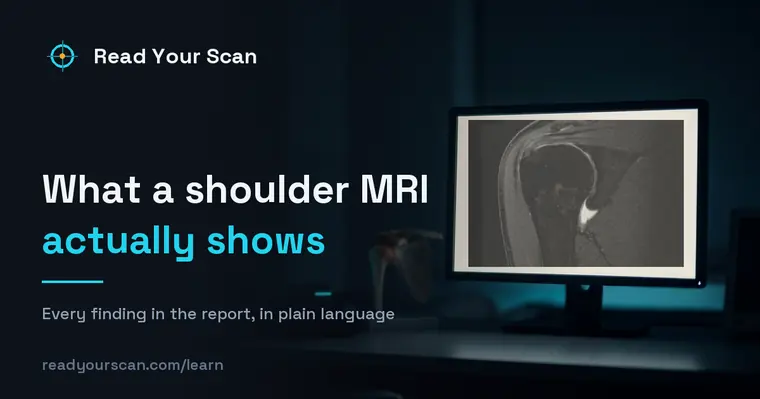
A shoulder MRI shows the rotator cuff muscles and tendons, the labrum (the cartilage rim of the socket), the biceps tendon, the joint surfaces, and the surrounding bones. Doctors order it for shoulder pain, weakness, limited movement, or after an injury. Some changes, like mild tendon wear, are common with age and may not fully explain symptoms — your doctor connects the images to your exam.

Common findings, in plain words
Rotator cuff tendinopathy
Wear or irritation of the rotator cuff tendons without a full tear. It is common, especially with age and repetitive use, and is often managed without surgery.
Rotator cuff tear (partial or full-thickness)
A tear in one of the rotator cuff tendons. The report describes whether it is partial or complete, which helps your doctor discuss options. Many are managed conservatively.
Labral tear
A tear of the cartilage rim around the shoulder socket. It can relate to instability or injury. Your doctor considers whether it fits your symptoms.
Subacromial bursitis
Irritation of the small fluid-filled cushion above the rotator cuff. It is a common source of shoulder pain and often calms with treatment.
AC joint arthritis
Age-related wear of the small joint at the top of the shoulder. It is very common and often causes little or no trouble on its own.
Biceps tendon changes
Irritation or wear of the biceps tendon where it attaches near the shoulder. Your doctor relates it to your symptoms.
Terms you might see
- Rotator cuff
- A group of four muscles and their tendons that stabilize the shoulder and help it move.
- Labrum
- A rim of cartilage around the shoulder socket that helps hold the joint stable.
- Tendinopathy
- A general term for wear or irritation of a tendon, short of a tear.
- Bursa
- A small fluid-filled cushion that reduces friction between tissues; when irritated it is called bursitis.
- Full-thickness tear
- A tear that goes all the way through a tendon, as opposed to a partial tear. It describes extent, not necessarily the treatment.
- Deltoid
- The large muscle over the outside of the shoulder that lifts the arm away from the body. It is usually mentioned only to say it looks normal, which is a useful comparison for the muscles underneath.
Questions to ask your doctor
- 1.Do the MRI findings explain the pain or weakness I feel?
- 2.Is any finding likely age-related rather than from a recent injury?
- 3.What are my options, including physical therapy and other non-surgical care?
- 4.If there is a tear, does it need surgery or can it be managed conservatively?
- 5.Do I need any follow-up, and when?
See these findings on your own scan
Upload your scan (de-identified in your browser) and your radiologist’s report, and every finding is mapped onto the images, explained in plain language and scored — free, no card needed. Informational only — not a diagnosis.
FAQ
- Does a rotator cuff tear on my MRI mean I need surgery?
- Not always. Many rotator cuff tears, especially partial or age-related ones, are managed with physical therapy and other non-surgical care. Your doctor weighs your symptoms and function alongside the images.
- What is tendinopathy?
- Tendinopathy is wear or irritation of a tendon without a full tear. It is common, especially with age or repetitive use, and often improves with treatment. Your doctor interprets how it relates to your symptoms.
- My report mentions AC joint arthritis — is that serious?
- Age-related wear of the AC joint at the top of the shoulder is very common and often causes little or no trouble on its own. Your doctor considers it in the context of your overall picture.
Related
Go deeper
Sources
- Patient-facing procedure descriptions (MRI, CT, X-ray, ultrasound)RadiologyInfo.org — Radiological Society of North America & American College of Radiology
- MRI scan — overview, how it is performed and resultsNHS (United Kingdom)
- ACR Appropriateness Criteria and practice parameters for reportingAmerican College of Radiology
Read Your Scan is informational only — not a medical diagnosis, and not a substitute for a licensed radiologist or your doctor. If you have urgent symptoms, seek care.