CT scan analysis · whole study, series by series
AI CT scan analysis that reads the whole study — not one screenshot of it
A CT is hundreds of slices across several series, and the report that comes back names findings nobody gave you the vocabulary for — including incidental ones nobody was looking for. Upload the study and it is read series by series, then explained in plain words, scored, and placed on the slice it came from.
Free viewer and free report explanation · $19 for the full AI reading · minutes, not weeks
- The whole DICOM study — hospital CD, USB, ZIP or NIfTI
- Name, IDs and dates stripped in your browser, before upload
- Contrast and non-contrast series read together
- Your doctor opens the shared link without an account
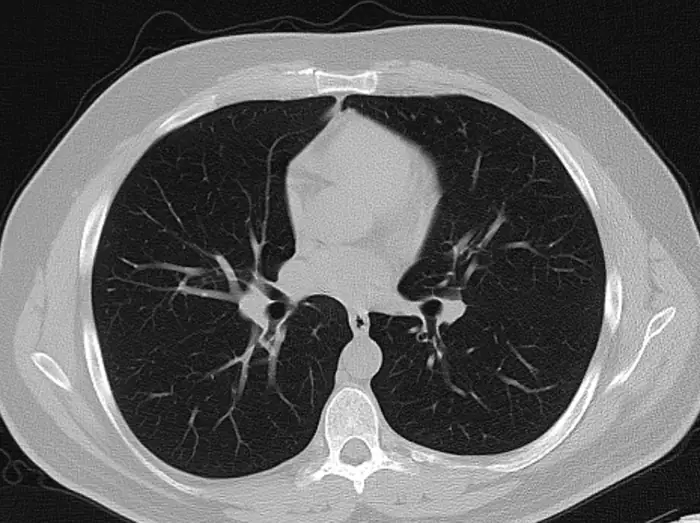
CT · chestNormal
“Lung parenchyma normally expanded, without focal lesions; hila and mediastinum unremarkable.”
→ Nothing in the lungs, nothing in the middle of the chest. This is what good news looks like when nobody translates it.
What happens when you paste a CT slice into ChatGPT
This is the real alternative most people try, so it deserves a straight answer rather than a strawman. A general chatbot will tell you something about that slice. Here is what it is working with while it does.
How much of the exam
The one screenshot you pasted. It cannot open a DICOM folder, cannot scroll a volume and has no idea the other three hundred slices exist.
The real study, read across every diagnostic series you upload — contrast and non-contrast, the axials and the reformats.
Where it is looking
A flat picture with no coordinates. Which plane, which level and which side are all inferred from what the image looks like.
Plane, slice position and the patient’s left and right come from the scan’s own geometry — the affine, not the appearance.
The model behind it
Whichever one the vendor is serving today. No medical-imaging model is reachable from a consumer chat window.
A measured roster — including Google’s MedGemma, gated and unavailable in any chatbot. The reader that wins on volumetric studies is the reader you get.
Incidental findings
Only if they happen to be in the slice you chose to screenshot — and a CT’s incidental findings are, by definition, the ones you did not know to look for.
Found across the study, then explained and scored — the things reports mention in one clause and patients worry about for a month.
What you walk away with
A hedged paragraph in a chat window, gone when the thread scrolls. Nothing your doctor can open.
A written report: every finding in plain language with a severity score, placed on the slice it came from, plus the questions worth asking — on a private link your doctor can open without an account.
Your report
Retyped by you, out of context, if you bother.
Uploaded whole and matched line by line to what is visible in the images. That part is free.
None of this makes the reading a diagnosis. It makes it a reading you can check, share and take to an appointment — which a chat message is not.
The readers
Models a chatbot cannot reach, chosen by measurement
A chatbot hands you whatever single model it happens to be running this month, and you have no say in it. We keep several readers and let measurement decide between them: they are compared head-to-head on real studies with a known diagnosis, and the one that wins on your kind of study is the one that reads yours. That is why a flat radiograph and a volumetric MRI do not go to the same model. The roster includes models built specifically for medical imaging that no chatbot can reach — Google’s MedGemma among them, a gated model you cannot get to from any consumer chat window.
- Claude Opus
- Gemini
- MedGemma 1.5
We do not claim a medical model reads every scan — we claim the winner does, and that we measured which one that is. When a general frontier model beats the medical one on a study type, the general one gets the work.
How a CT reading works
A CT is expensive to read properly — hundreds of slices of real vision tokens — so the credit comes first here and the reading is thorough rather than sampled.
Step 1 · free
Upload the study
The DICOM folder from the hospital CD or USB, a ZIP of it, or a NIfTI file. Drop the whole thing — the series are detected for you. Identifying details are stripped in your browser first.
Step 2 · free
Add the radiologist’s report, if you have one
Every sentence in it is matched to what is visible in your images and rewritten in plain language. This step costs nothing and works on its own, whatever you decide about the reading.
Step 3 · $19
The full AI reading
The study is read series by series, working from the scan’s own geometry, with your age, sex and symptoms in hand. Out comes a report: findings in plain words, each one scored and placed on its slice.
Step 4 · free
Ask it questions, then share it
Follow-up questions on a reading you have paid for cost nothing, and they are grounded in your study rather than in general knowledge. Send the whole thing to your doctor on a private link.
What the reading actually contains
Written for you to read, and built for your doctor to open.
Every series, not a sample
The reading covers the diagnostic series you upload — contrast and non-contrast together, not one representative image from each.
Incidental findings explained
The things found by accident are the ones reports explain least and patients worry about most. They get a paragraph here, not a clause.
A severity score per finding
So routine wear reads differently from the thing worth a phone call, instead of everything arriving at the same alarming volume.
The finding placed on its slice
Click a finding and the viewer moves to the slice and region it describes. You see the area, not just its name.
Your report, line by line
The radiologist’s sentences matched to what is visible and rewritten in plain words — free, with or without the AI reading.
A private link to share
Send the images and the reading to a doctor or a family member. No account needed on their side, revocable whenever you want.
When a CT reading is worth paying for
Not always. It earns its place in a few specific situations, and it is fair to say which.
The report named something incidental
A cyst, a nodule, a calcification, a “clinical correlation recommended”. One clause in the report, four weeks of worry, and nobody available to say how much attention it actually warrants.
The follow-up is weeks away
Understanding the report now does not replace the appointment. It is what turns the appointment from being told things into asking the right things.
You want the images read, not just the report explained
The reading works from the images and is deliberately blind to your radiologist’s report. Where the two agree, you can stop worrying. Where they differ is what to ask about.
The report is in a language you do not read
Imaging done abroad, or in a country whose reports come back in a language you never learned. The explanation comes back in yours.
What this cannot do
The honest half of the pitch. A tool that will not say this is not being straight with you.
It is not a diagnosis
Nobody licensed signs it. It explains what is visible in your study; naming a disease, ordering the next test and treating you are your doctor’s job and only your doctor’s.
It cannot tell you whether you have cancer
It describes what is visible and how much attention it warrants. A finding that needs answering is a conversation with your doctor, and the reading is built to help you have it — not to have it for you.
It has no prior studies
Half of what a radiologist knows about a nodule is how it compares to last year’s scan. The reading sees today’s images only, and says so instead of pretending to a trend.
It has no history but the one you type
Your radiologist has your chart, your bloods and the referral. The reading has the images, your age and sex, and whatever symptoms you chose to describe.
What it costs
One exam
$19
One whole CT study read across its series, with the full report. One-off payment, no subscription, no account to cancel.
Three examssave 21%
$45
$15 an exam. For a follow-up series, or for reading a relative’s studies too. Credits never expire.
- The 3D viewer and the DICOM tools are free, always, with no account
- Reading your radiologist’s report and mapping it to the images is free
- Follow-up questions on a reading you have paid for cost nothing
- Credits never expire and there is nothing recurring to cancel
CT questions
- What do I upload for a CT?
- The DICOM folder from the hospital CD or USB stick, a ZIP of it, or a NIfTI file. Contrast and non-contrast series can be uploaded together — drop the whole study and the series are detected for you.
- Why not just paste a slice into ChatGPT? That is free.
- Because a CT is not one slice. A general chatbot cannot open a DICOM folder, cannot scroll the volume, and is looking at whichever single compressed screenshot you happened to choose — which is exactly the wrong tool for a study whose point is the findings you did not know to look for. It also has no access to any medical-imaging model, and produces nothing you can hand to a doctor.
- Which model reads it?
- Whichever one wins on volumetric studies in our own head-to-head testing against studies with a known diagnosis — the roster includes Claude Opus, Gemini and Google’s MedGemma, the last of which is a gated medical-imaging model no chatbot can reach. Routing is by study type: a CT volume and a flat X-ray do not go to the same reader.
- Will it tell me whether I have cancer?
- No. It describes what is visible in the images in plain language and cannot diagnose anything. A finding that needs answering is a conversation with your doctor, and the reading is built to help you have it.
- How much does it cost?
- The viewer is free and explaining your radiologist’s report is free. The full AI reading of the images costs $19 — a credit you buy once, that never expires, and that unlocks one complete reading. Three exams cost $45.
- How long does it take?
- Minutes for most studies. A large multi-series CT takes longer than a single-series one, and the page tells you where it is rather than leaving you on a spinner.
- What happens to my images?
- Identifying details are stripped from the DICOM files in your browser, before upload. The images are yours, stored against your account, deletable at any time, and shared only through links you create and can revoke.
Your CT was read once, in ten minutes, by someone with forty more to get through.
Have the images read again from scratch, in plain language, with every finding scored and placed where you can see it — and walk into your appointment knowing what to ask.
$19 for one exam · explaining your report is free · not a diagnosis
Related
Read Your Scan provides informational explanations only — not a medical diagnosis, and not a substitute for a licensed radiologist or your doctor.