Meniscus tear
Read Your Scan Editorial Team·Last updated
Written from published radiology references and reviewed for plain language. Not written or signed by a physician, and not a diagnosis. How we write these pages →
In plain language
A tear in one of the C-shaped cushions in the knee. Tears range widely, and some — especially age-related ones — cause few or no symptoms. Your doctor considers whether it explains what you feel.
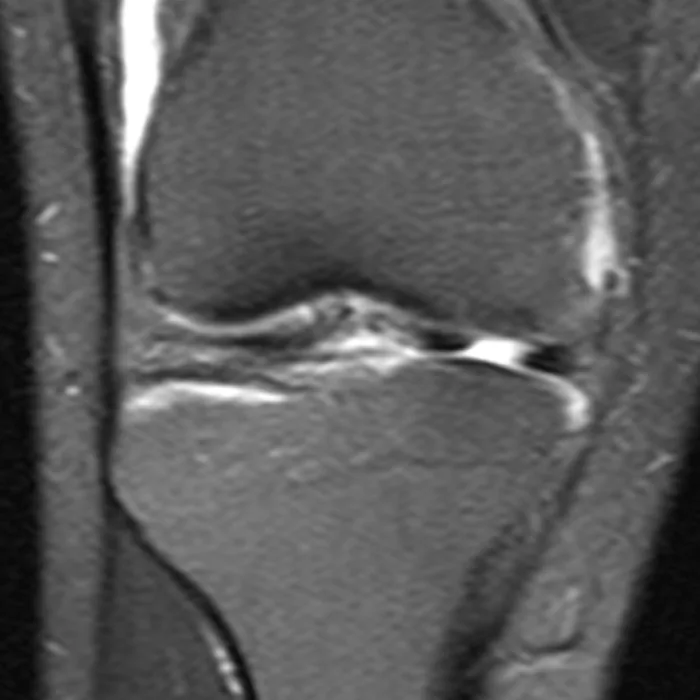
Ciernik M, Wikimedia Commons · CC BY-SA 4.0
Upload your MRI, CT, X-ray or ultrasound — de-identified in your browser — and every finding is mapped onto your images and explained without jargon.
Where you'll see this
This wording turns up on Knee MRI reports — MRI imaging of the knee. A knee MRI is very good at showing soft tissues that X-rays cannot, including the menisci (the knee’s cushions), the major ligaments, the tendons, the joint cartilage, and the bones. Doctors order it after an injury, for pain, swelling, locking, or instability, or to plan treatment. Some findings, like mild wear, are common with age and may not be the source of symptoms — your doctor connects the images to your exam.
Questions worth asking your doctor
- Do the MRI findings explain the pain, swelling, or instability I feel?
- Is any finding likely age-related rather than from a recent injury?
- What are my treatment options, including non-surgical ones?
- Would physical therapy help before considering other steps?
- Do I need any follow-up, and when should I check back?
How common is this?
Very common. Meniscus tears show up on MRI in about 35 % of people over 50 even without knee symptoms. In younger adults they are typically sports injuries. They are one of the most common knee injuries overall.
When should I worry?
A tear matters when it causes mechanical symptoms: locking (the knee gets stuck), catching, giving way or significant swelling after activity. Degenerative tears in adults over 40 often cause no symptoms and may not need any treatment. Acute traumatic tears in younger, active patients may warrant intervention.
What happens next
Degenerative or small stable tears → physical therapy (quadriceps and hamstring strengthening), anti-inflammatory medication and activity modification. Most improve within 6–12 weeks. Tears causing locking or catching → arthroscopic surgery may be discussed. Not every tear seen on MRI needs surgery.
Frequently asked questions
- Does a meniscus tear require surgery?
- Not always. For degenerative tears in adults over 40, physical therapy is often as effective as surgery. Surgery is mainly considered for tears causing mechanical symptoms (locking, catching) in younger, active patients.
- Can a torn meniscus heal on its own?
- Small tears in the outer zone (which has blood supply) can heal. Tears in the inner zone generally do not heal but may never cause problems. A tear does not always need to heal to stop hurting.
- How long is recovery from meniscus surgery?
- Arthroscopic trimming (partial meniscectomy) typically allows return to normal activities in 4–6 weeks. Meniscus repair (stitching) requires 3–6 months for the repaired tissue to heal.
- Can I still exercise with a meniscus tear?
- Usually yes. Low-impact activities — swimming, cycling, walking — are generally safe. Avoid deep squats, pivoting and impact sports until symptoms resolve. A physiotherapist can design a safe programme.
Other words on the same report
Where this word comes up
Still worried about what your report says?
Upload your scan (de-identified in your browser) and your radiologist's report, and every finding is mapped onto the images, explained in plain language and scored. Informational only — not a diagnosis.
Read Your Scan is informational only — not a medical diagnosis, and not a substitute for a licensed radiologist or your doctor. If you have urgent symptoms, seek care.