Rotator cuff tear (partial or full-thickness)
Read Your Scan Editorial Team·Last updated
Written from published radiology references and reviewed for plain language. Not written or signed by a physician, and not a diagnosis. How we write these pages →
In plain language
A tear in one of the rotator cuff tendons. The report describes whether it is partial or complete, which helps your doctor discuss options. Many are managed conservatively.
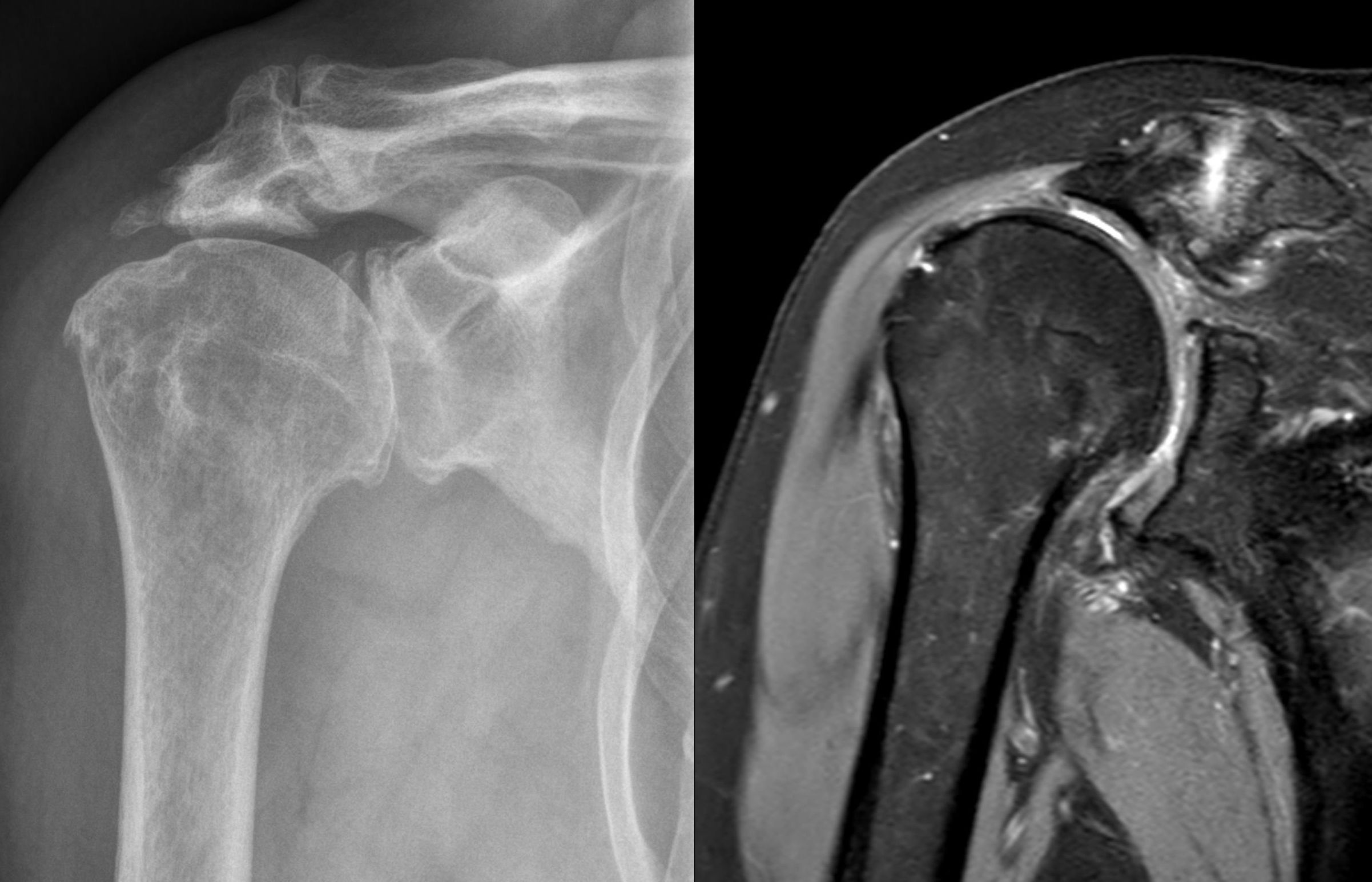
Hellerhoff, Wikimedia Commons · CC BY-SA 4.0
Upload your MRI, CT, X-ray or ultrasound — de-identified in your browser — and every finding is mapped onto your images and explained without jargon.
Where you'll see this
This wording turns up on Shoulder MRI reports — MRI imaging of the shoulder. A shoulder MRI shows the rotator cuff muscles and tendons, the labrum (the cartilage rim of the socket), the biceps tendon, the joint surfaces, and the surrounding bones. Doctors order it for shoulder pain, weakness, limited movement, or after an injury. Some changes, like mild tendon wear, are common with age and may not fully explain symptoms — your doctor connects the images to your exam.
Questions worth asking your doctor
- Do the MRI findings explain the pain or weakness I feel?
- Is any finding likely age-related rather than from a recent injury?
- What are my options, including physical therapy and other non-surgical care?
- If there is a tear, does it need surgery or can it be managed conservatively?
- Do I need any follow-up, and when?
How common is this?
Very common, especially with age. Partial tears appear on MRI in about 25 % of asymptomatic people over 50. Full-thickness tears are found in roughly 20 % of people in their 60s and 50 % in their 80s — many never know they have one.
When should I worry?
The tear matters if it limits function: inability to lift the arm above shoulder height, night pain that prevents sleep, or weakness when reaching. A tear found incidentally in an older adult without symptoms often needs no treatment. An acute traumatic tear in a younger, active person is more significant.
What happens next
Partial tears and chronic tears in older adults → physical therapy to strengthen the remaining rotator cuff and deltoid, plus anti-inflammatory measures. 6–12 weeks for meaningful improvement. Acute full-thickness tears in active patients → arthroscopic repair may be recommended. Recovery from surgery: 4–6 months.
Frequently asked questions
- Does a rotator cuff tear always need surgery?
- No. Many partial and chronic full-thickness tears respond well to physical therapy. Surgery is mainly for acute tears in active patients, large tears with significant weakness, or when therapy fails after several weeks.
- Can a partial tear become a full tear?
- It can, but it does not always. Small partial tears may remain stable for years. Risk of progression is higher with continued overhead activities, larger tears (over 50 % thickness) and lack of rehabilitation.
- What does “partial-thickness” vs “full-thickness” mean?
- Partial: some fibres are torn but the tendon is not completely through. Full-thickness: the tear goes all the way through, creating a hole. Full-thickness does not necessarily mean the tendon has fully retracted.
- How long does rotator cuff recovery take?
- With therapy alone: 6–12 weeks for significant improvement. After surgical repair: sling for 4–6 weeks, therapy for 4–6 months, full recovery 6–12 months. The tear size and type affect the timeline.
Other words on the same report
Still worried about what your report says?
Upload your scan (de-identified in your browser) and your radiologist's report, and every finding is mapped onto the images, explained in plain language and scored. Informational only — not a diagnosis.
Read Your Scan is informational only — not a medical diagnosis, and not a substitute for a licensed radiologist or your doctor. If you have urgent symptoms, seek care.