Pulmonary nodule
Read Your Scan Editorial Team·Last updated
Written from published radiology references and reviewed for plain language. Not written or signed by a physician, and not a diagnosis. How we write these pages →
In plain language
A small round spot in the lung. Nodules are very common and most are harmless — scar tissue or a past infection. Reports often note the size; small ones are frequently just watched over time. Your doctor will decide whether it needs any follow-up.
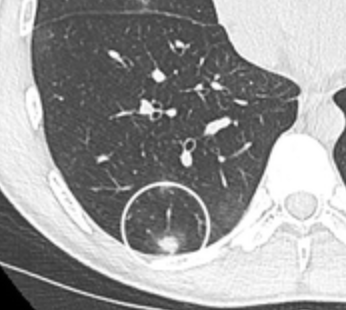
Snoeckx A et al., Insights Imaging 2017 · CC BY 4.0
Upload your MRI, CT, X-ray or ultrasound — de-identified in your browser — and every finding is mapped onto your images and explained without jargon.
Where you'll see this
This wording turns up on Chest CT reports — CT imaging of the chest. A chest CT gives a much more detailed view than a regular chest X-ray. It shows the lungs and airways, the space between the lungs (the mediastinum), lymph nodes, blood vessels, the heart’s outline, and the chest wall. Doctors order it to look more closely at a cough, shortness of breath, an abnormal X-ray, a known nodule, an infection, or to check blood vessels. Seeing something on the images does not by itself mean something is wrong — your doctor reads the pictures together with your history and other tests.
Questions worth asking your doctor
- What was the main reason this chest CT was ordered, and did it answer that question?
- Were any findings unexpected, and do any of them need follow-up?
- If a nodule was seen, does it need another scan later, and when?
- Do the results change anything about my current treatment or medications?
- Is there anything in my history that helps explain what the report describes?
How common is this?
Very common. Pulmonary nodules show up in up to 50 % of chest CTs. Over 95 % are benign — old infections, small lymph nodes or scarring. They are so common that radiology societies have developed specific guidelines (Fleischner criteria, Lung-RADS) for managing them.
When should I worry?
A nodule raises concern if it is growing on serial scans, is larger than 8 mm, has irregular or spiculated margins, contains a solid component (in a ground-glass nodule), or if you have risk factors — smoking history, family history of lung cancer, age over 50. Small, smooth, stable nodules are almost always benign.
What happens next
Nodules under 6 mm in low-risk patients often need no follow-up at all. Nodules 6–8 mm typically get a follow-up CT at 6–12 months. Larger or suspicious nodules may warrant PET scan, biopsy or pulmonology referral. Stability over 2 years of monitoring is strong evidence of benignity.
Frequently asked questions
- Does a lung nodule mean cancer?
- Very unlikely. Over 95 % of incidentally found lung nodules are benign. Cancer risk depends on size, shape, growth rate and your personal risk factors. Small, smooth, stable nodules are almost always non-cancerous.
- How often should a lung nodule be monitored?
- Depends on size: under 6 mm in a low-risk patient may need no follow-up. Nodules 6–8 mm typically need one CT at 6–12 months. Larger nodules may need scans at 3, 6 and 12 months. Your report should include a follow-up recommendation.
- What causes lung nodules?
- Common benign causes: old infections (TB, fungal), inflammation, lymph nodes, hamartomas (benign growths) and scarring. Less commonly, nodules represent primary lung cancer or metastases from cancer elsewhere.
- What does “Fleischner criteria” mean in my report?
- Evidence-based guidelines radiologists use to decide whether and when a nodule needs follow-up imaging. They consider size, number and risk factors to avoid unnecessary procedures while catching genuinely suspicious findings.
Other words on the same report
Where this word comes up
Still worried about what your report says?
Upload your scan (de-identified in your browser) and your radiologist's report, and every finding is mapped onto the images, explained in plain language and scored. Informational only — not a diagnosis.
Read Your Scan is informational only — not a medical diagnosis, and not a substitute for a licensed radiologist or your doctor. If you have urgent symptoms, seek care.