Spinal stenosis
Read Your Scan Editorial Team·Last updated
Written from published radiology references and reviewed for plain language. Not written or signed by a physician, and not a diagnosis. How we write these pages →
In plain language
A narrowing of the space around the spinal canal or nerves. It can be mild, moderate, or severe. Your doctor interprets the narrowing alongside your symptoms.
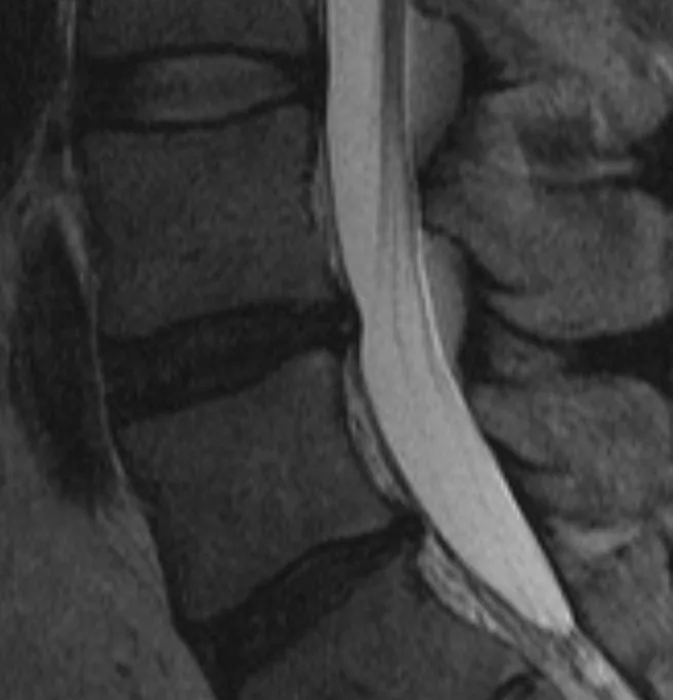
Stillwaterising, Wikimedia Commons · CC0
Upload your MRI, CT, X-ray or ultrasound — de-identified in your browser — and every finding is mapped onto your images and explained without jargon.
Where you'll see this
This wording turns up on Lumbar Spine MRI reports — MRI imaging of the spine. A lumbar (low-back) MRI shows the vertebrae, the cushioning discs between them, the spinal canal, and the nerves that travel to the legs. Doctors order it for low-back pain, sciatica, leg numbness or weakness, or to plan care. Importantly, many of the changes it describes are extremely common and are seen in people with no pain at all — so the report is read together with how you actually feel.
Questions worth asking your doctor
- Do the findings on the MRI match where I actually feel pain or symptoms?
- Are these changes common for my age, or is anything unusual?
- What are my non-surgical options, such as physical therapy?
- Are there any signs that would mean I should seek care sooner?
- Do I need any follow-up imaging, and when?
How common is this?
Very common over 50. Lumbar spinal stenosis affects about 11 % of the general population and up to 50 % of adults over 65 show some narrowing on imaging. It is the most common reason for spinal surgery in people over 65.
When should I worry?
The finding is a description of narrowing, not a diagnosis by itself. It matters when symptoms match: leg pain or cramping when walking (neurogenic claudication) that improves when you sit or lean forward, or progressive weakness. Mild stenosis without symptoms is rarely concerning.
What happens next
Asymptomatic or mild → monitored. Symptomatic → physical therapy (flexion-based exercises, core stability) is first-line. Epidural steroid injections may help short-term. Surgical decompression (laminectomy) is considered when walking tolerance drops significantly and conservative measures have been given a fair trial.
Frequently asked questions
- Does spinal stenosis get worse over time?
- It can progress slowly, but many people remain stable for years. Symptoms do not always correlate with the degree of narrowing on imaging.
- Can exercise help spinal stenosis?
- Yes. Activities that flex the spine forward — cycling, swimming, walking with a slight lean — often relieve symptoms by opening the canal. Extension exercises (arching backward) may aggravate them.
- Is spinal stenosis the same as a herniated disc?
- No. Stenosis is canal narrowing, usually from bone spurs, thickened ligaments or bulging discs. A herniated disc is a specific disc problem that can contribute to stenosis but is a different finding.
- What does “moderate” stenosis mean?
- Stenosis is graded mild, moderate or severe by how much the canal is narrowed. Moderate means visible narrowing but the cord or nerves still have some room. Treatment depends on symptoms, not the grade alone.
Other words on the same report
Where this word comes up
Still worried about what your report says?
Upload your scan (de-identified in your browser) and your radiologist's report, and every finding is mapped onto the images, explained in plain language and scored. Informational only — not a diagnosis.
Read Your Scan is informational only — not a medical diagnosis, and not a substitute for a licensed radiologist or your doctor. If you have urgent symptoms, seek care.